
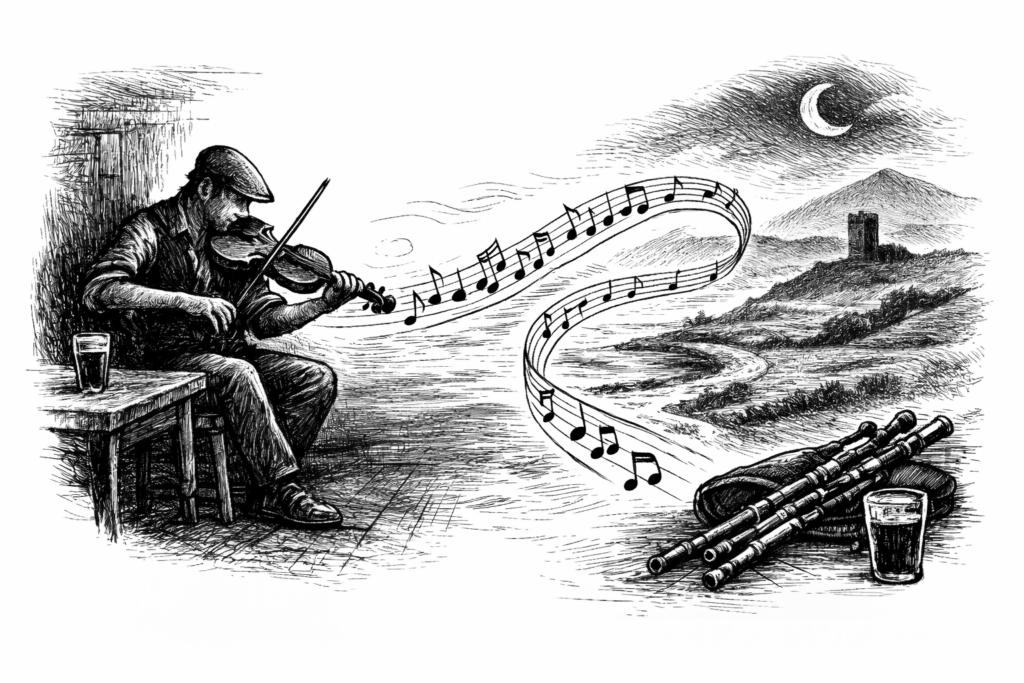
I have learned something about myself by playing Irish traditional music,
something I didn’t set out to learn,
something that arrived the way real knowledge arrives:
not as an opinion, but as a bodily certainty.
I trust the tune.
Not “music” in general — not sound, not style, not culture —
but the tune itself, the single living line,
and the rhythm that lives inside it like bone inside the hand.
A line of melody
You can’t fake lift.
You can’t fake swing.
You can’t fake the forwardness that makes a reel feel right.
The tune either stands up, or it collapses.
No ornament will save it.
No speed will hide it.
No cleverness will disguise it.
There is a kind of mercy in that honesty.
I’ve listened to music where harmony arrives like a beautiful coat thrown over a thin frame.
It warms the listener instantly.
It convinces.
It paints the room in feeling.
And I don’t deny its power.
I feel the seduction of it as clearly as anyone.
But I also feel the trick.
Because harmony can give the impression of depth without the labour of depth.
It can persuade you that something is profound because it has colour.
It can make emotion appear on demand,
as if the music were a theatre cue:
now we are longing,
now we are broken,
now we are saved.
It is a form of storytelling that knows how to move you.
But trad is not always a storyteller.
Trad can be something older and harder:
a thing that refuses to perform feeling,
a thing that will not decorate grief,
a thing that can carry joy without glitter
and sorrow without explanation.
It doesn’t always tell you what to feel.
It gives you a line, and asks you to live inside it.
That is the ethic of it, I think.
A kind of discipline.
A kind of dignity.
In a world full of persuasion,
a single melodic line feels like an oath.
Sometimes I think of it like photography.
Colour is powerful.
Colour is convincing.
Colour is immediate authority.
You see it and the mind says: yes — that must be real.
But black and white has no such luxury.
Black and white has to earn you.
It lives on contrast and structure,
on shape,
on timing,
on shadow that is not a trick but a fact.
It has punch because it has nothing to hide behind.
This is what the tune feels like to me:
black and white that refuses to flatter.
A line that doesn’t beg for attention.
A rhythm that doesn’t require belief — it proves itself.
A good tune doesn’t need to announce its power.
It doesn’t need to expand into a cathedral of chords to be “important.”
It can be small and still be infinite.
It can be repeated and still be new.
It can circle the same few steps and still walk you somewhere you haven’t been before
a slightly different touch,
a new glint of light on the surface.
Harmony often wants to decide things.
it introduces authority:
this is the right chord,
this is the correct change,
this is where we land.
A tune with real rhythm is a thing that stands up on its own.
it can move you without colour,
without architecture,
without persuasion —
then you know you are in the presence of the real thing.
Not music that convinces you.
Music that doesn’t need to.
Music that simply is.
The line.
The lift.
The honest pulse inside the melody.
Leave a Reply