“For us believing physicists, the distinction between past, present and future is only a stubbornly persistent illusion.”1
A month before his death, and two months before my birth, Albert Einstein wrote a letter of condolence to the family of his close friend, Michele Besso. In it, he offered the view above.
Outline of the essay
I begin with my own phenomenological experience of the “now” and a story based on Valtonen’s three-body work2, which I use to develop a candidate for a finite time-window τ based on the Lyapunov time. I then examine McTaggart’s classical argument3 for the unreality of time and Broad’s alternative4. I present my main argument, which relocates change from metaphysical A-properties to non-linear, irreversible, asymmetric physical relations, and show that my experience is consistent with this argument. I conclude that the “now” is real.
Experience of the “now”
I am aware of the “now” moment, I reflect on the past, I imagine the future but the “now” is an experience. I can remember a frightening moment and feel the fear, but not in the same way as being in it. If I awake from a nightmare, the moment I realise it is a dream, I still retain the emotions, but the realisation moment changes the “now”.
The “now” does not feel like a point in time; it has a feeling of width, it extends a little back, it lingers, and it extends a little forward, it anticipates. Some describe time as a flowing state, with the “now” moving. I think of time more like the fly fisherman at the head of the salmon pool seeing the water toss into the pool and settle. The direction of flow is from fixed memory towards a settling “now” towards an unfixed future of potential.
A classical independent view is expressed in the poem – The Waterfall5 by Mary Oliver, and I particularly refer to the final lines;
“finally, in the deep and green and utterly motionless pools after all that falling? “
The Race of the Asteroids – a story
Zeus was bored, so one day he held a race. His two best asteroids, M and N were set in motion racing across the outer reaches of the solar system. He asked the Sun to arrange a beam of light from beyond the planets. When the light beam reached the racecourse, 30 AU from Neptune, the race began, and when the light reached Neptune, the winner was announced.
The race was a great success. The first asteroid M was out in front, but N was in hot pursuit. Gravity pulled back M but accelerated N so N finally passed M, angular momentum was the jockey that kept them from colliding as they passed. The race continued with both asteroids passing each other until the light reached Neptune, one was declared a winner.
After a few races the planets realised that by measuring the initial conditions of the asteroids as the light approached the racecourse in the darkness beyond Neptune, they could predict the see-sawing motion accurately.
Zeus, annoyed, decided to enter a third asteroid, O. Now the motion of the three became chaotic with M rushing ahead for long periods, the three quickly changing positions, the results appearing truly random. But again, the planets found that by measuring the initial conditions accurately, which they called the form, they could predict the winner.
Zeus imposed an uncertainty limit: no matter how carefully the planets measured the form, they could not know the result exactly. The uncertainty was tiny but in a chaotic system it would grow exponentially. He extended the light path to Earth where its arrival would signal the race end. The planets could predict outcomes faithfully for a while, but beyond a certain time, Lyapunov timescale, the certainty dissolved into probability. They, like Zeus, would know the odds, but not the outcome.
The planets complained that if they could not measure things accurately, how would they ever know if Zeus was cheating. Zeus agreed to write down the rules of the race for all time; the planets could calculate and check that every motion followed those rules exactly. He called his rules the General Theory of Relativity in the Race of the Asteroids and placed a copy at the light beam end point, Earth, so that all could see. The race is run every day, and no one has yet been able to consistently beat the odds set by Zeus.
Thought experiment
Thinking about the story, I imagined an experiment performed by one of the planets. In his laboratory analysing the trajectory of the three asteroids, he would take his real measurements and run a simulation on his computer, writing into three columns: A column, the winners, B column, the logical order of winners, Column his model’s predictions. I realised that he need not fill in the B series. No information leaves the volume. We define V throughout as a local volume of 4D spacetime. There is much happening in an unpredictable way but no new information, no real change. The planet cannot predict the outcome of the race past the Lyapunov time, yet for every conceivable experiment that he might run, the B series is logically fixed, known, but just not to him. The outcomes are indexed to time.
I ran a second thought experiment replacing the Newtonian physics with general relativity. In GR, gravitational interactions are dissipative through radiation. The motion of the masses creates information that needs to be shared with the rest of the universe. Every Lyapunov time scale, the system must radiate a unit of entropy. The race outcomes are now indexed to time and conditional on entropy having increased along the history.
This is fundamentally different. In the classical case the system is informationally closed: everything is determined, and our inability to predict is purely a limitation of measurement, not of reality. The B-series is fixed, and ignorance of its order is an epistemic fact about us, not an ontological fact about the world. In the general relativistic case, something physically different happens. The radiation of gravitational energy is lost information from the closed volume. The local system that existed before the radiation is not the same one that exists after it. A new physical state has come into being, and the old one is gone. This is a claim about what exists in V. It is an emergence of a new state in a period τ, a new becoming.
It is important to note that this does not make the “now” observer dependent. The τ associated with a specific V is a property of that region’s chaotic physical processes, not of whoever happens to be looking. When I later discuss experiencing the “now”, I am speaking of a different τ which is the experiential coherence window of a cognitive system, which varies between observers. This is an integration period τ not a formation period τ, but they both apply a non-linear process, one to agree paths and the other to agree truths. But a every volume of spacetime has a unique τ, the becoming window of the region.
McTaggart, Broad, and the classical debate
The three familiar positions in the philosophy of time are: eternalism, where past, present, and future are equally real and the “now” is merely a perspective within a fixed four-dimensional block; presentism, where only the present exists; and the growing block, associated with Broad, where the past and present are real but the future is not yet real. In my view the future is real, because my future could be an observers present, or past. The process of becoming consists in the local information update within V as information (gravitational radiation) arrives or leaves.
I therefore propose a fourth view, the block is eternal. It is like a library, truth are books on the shelf, but a librarian is using not one but two non-linear rules, the first is logic to decide if it is a book, and a second non-linear rule chaos to decide the path to its location. The truth exists at a co-ordinate in spacetime, but the exact location is being, or will be decided.
The classical challenge comes from McTaggart3. In his famous argument he constructs the A and B series. In the A series events pass through the present, from future to past. Events in the B series are a permanent record of their ordering. He argues that events must have the mutually exclusive properties of futurity, presentness and pastness all at once, which is contradictory, and therefore time is not real.
McTaggart sees the “specious present” as a further problem: if the present has a width, that width depends on the observer and is not objective. To address this, we need to deal with two situations: two distant observers, and two observers in the same space. The first is handled by defining a local coherence period τ in each V, local time is chosen based on general relativity. The second is handled by defining an integration τ of an observer: a professional tennis player will experience a different “now” when addressing a ball serve than an amateur. While τ may appear arbitrary, it is not. It is the Lyapunov time period of the observer’s integration process combined with the Lyapunov time period of process in the local volume.
McTaggart also says that there is no independent way to validate time other than experience. It is subjective. But the arrow of time does emerge, as Valtonen2 argues: “as soon as the universe has at least three particles, the Arrow of Time appears; it is the direction into which the Kolmogorov-Sinai entropy increases.” This points to entropy as an arrow of time.
Finally, McTaggart assumes that pastness, presentness, and futurity are intrinsic properties an event simply has, independently of its relations to other events or processes. This is what generates the contradiction: an event must have all three, yet they are incompatible.
But the entropy reformulation challenges this at the root. If what distinguishes past from future is not a primitive A-property but rather the direction of irreversible physical processes such as entropy increase, information dispersal, the asymmetric radiation of energy. Then past and future are not intrinsic properties of events at all. They are relational and processual. An event is “past” relative to V not because it possesses some metaphysical property of pastness, but because its information has irreversibly dispersed beyond V’s local domain. The co-ordinates of truths are fully known.
On this account, McTaggart’s contradiction simply does not arise. There is no single moment at which an event must simultaneously bear all three properties. Instead, there is a physical process, a Lyapunov-scaled becoming, through which states transition from informationally unresolved (future) to locally integrated (present) to informationally dispersed (past). These are stages in a process, not simultaneous property-attributions.
A closely related approach is found in C.D. Broad4 ’s Scientific Thought. Broad says: “The past and present are real, but they are not real in the same way. The present consists in events undergoing becoming: the ontological transition in which possibilities become actual. The past consists in events that remain real as fixed achievements of that process. The future is unreal, not because it is unknown, but because it has not yet been generated.”
Broad avoids the McTaggart paradox by refusing to attach properties to what does not exist. Time is real, but the future is not. I find this a powerful and radical move. It recalls, in reverse, the story from Antoine de Saint-Exupéry, where Bedouin visitors, brought to see a waterfall, wanted to remain until the water stopped. The possibility that the waterfall might stop captures real change.
Here, as a Physicist, I part company with Broad. Future propositions are true or false. What is missing is their exact location in V, not truth-value. Broad says future propositions are neither true nor false because the future does not exist. I agree with Broad that the future cannot serve as a local truth-maker, but unlike Broad I maintain their truth-makers are not locally accessible to V.
In a system governed by general relativity, the physical state that would serve as truth-maker exists in the future region. Becoming resolves the path. It is not hidden from us; it is present in reality (future region) but hidden from local V ontologically.
Broad’s position is that events emerge, become in the present, then exist in the past. They do not exist in the future. In my view, when a relationship refers to an event at time, t with t > tp + τ, where tp is the current time on a local clock, then the truths are contingent on facts not locally settled. If t < tp + τ and t > tp truths are contingent on facts being settled, and if t < tp all truths are fixed. They are fixed ontologically in the past, but because the information has dispersed the settlement is not known: entropy is not zero.
Broad also argues that the laws of identity, contradiction, and excluded middle assert that any proposition is either true or false but do not assert that the number of propositions is eternally fixed. They only assert it cannot be diminished; it may be increased by the process of becoming, which continually augments the sum-total of existence. I take this as my starting point.
As a physicist my instinct is to look at entropy. The time t can advance without change, as with the inert rock. Reversible processes show motion without irreversible change. The fundamental laws of physics do not show an arrow of time; it must come from entropy. Relativity forbids a global “now” based on t but permits local change related to entropy. The “now” correlates with Lyapunov time and entropy production, not with coordinate intervals of time. I argue that events are not indexed to local time they are contingent on local entropy. There co-ordinates in spacetime are not settled. The B series has future uncertainty.
Broad’s coat analogy is useful here. He said he might need his coat at night but not during the day: the truth of Coat or not-Coat is based on local conditions of temperature and dampness. A local equilibrium distribution gives a factual and real account of the conditions. Temperature is not defined globally but within a local space. Entropy can also be defined locally and is the ratio of heat transfer to temperature, it is what has happened in a directional sense, and what is happening in the “now”.
The main argument
My argument is that McTaggart’s contradiction does not show that time is unreal. It shows only that time cannot be understood if change is modelled as the acquisition of incompatible intrinsic A-properties by events. Once change is relocated to a non-linear process, which is irreversible, the contradiction no longer applies. Thermodynamic and informational asymmetries explain why past, present, and future are differently accessible from within a V, without implying that logic itself changes.
A committed eternalist might object that none of this escapes the block universe. Physical irreversibility, on this view, is simply a feature of the block’s internal structure: the arrow of time is baked into the four-dimensional manifold, and entropy increase is an asymmetry within it. My claim is about what irreversibility means when taken ontologically, not just descriptively. If the exact 4D location of a state remains uncertain, the physical state exists but has not yet been informationally integrated into V.
My claim is that a physical state becomes locally determinate when it is informationally integrated into V. It goes through a process filter, which is a non-linear filter when τ < infinity, to determine its location. This alters a one-dimensional ordering, even time. The process filter is chaos, and it has a Lyapunov time period, τ. It achieves this through irreversible processes, when the gravitational radiation has been emitted, the entropy produced, the quantum superposition resolved. Before that process has taken place, truth has no exact location, not because we can’t see it, but because the physical process that would determine it have not yet occurred.
A stone falls into a pool, and a frog sits on a rock nearby. The stone enters the water, but the frog does not register this immediately. The sight reaches him quickly, the sound reaches him later, and the wave later again. What counts as “now” for the frog is not the moment the stone hits the water, but the moment the information arrives. This shows that the present is not a sharp boundary shared by all events, but a locally constructed window shaped by when information becomes available.
The frog example illustrates the experiential now, the integration of information and the application of a non-linear filter to establish truths. It also shows the need for a coherence window, τ. It does not, by itself, refute eternalism. The ontological claim is that the information goes through another filter: a chaotic filter, a decoherence period τ. Before arriving at the frog, the ripple in the water might cause the bank to collapse. This is a 4D uncertainty resolution process occurring in every V.
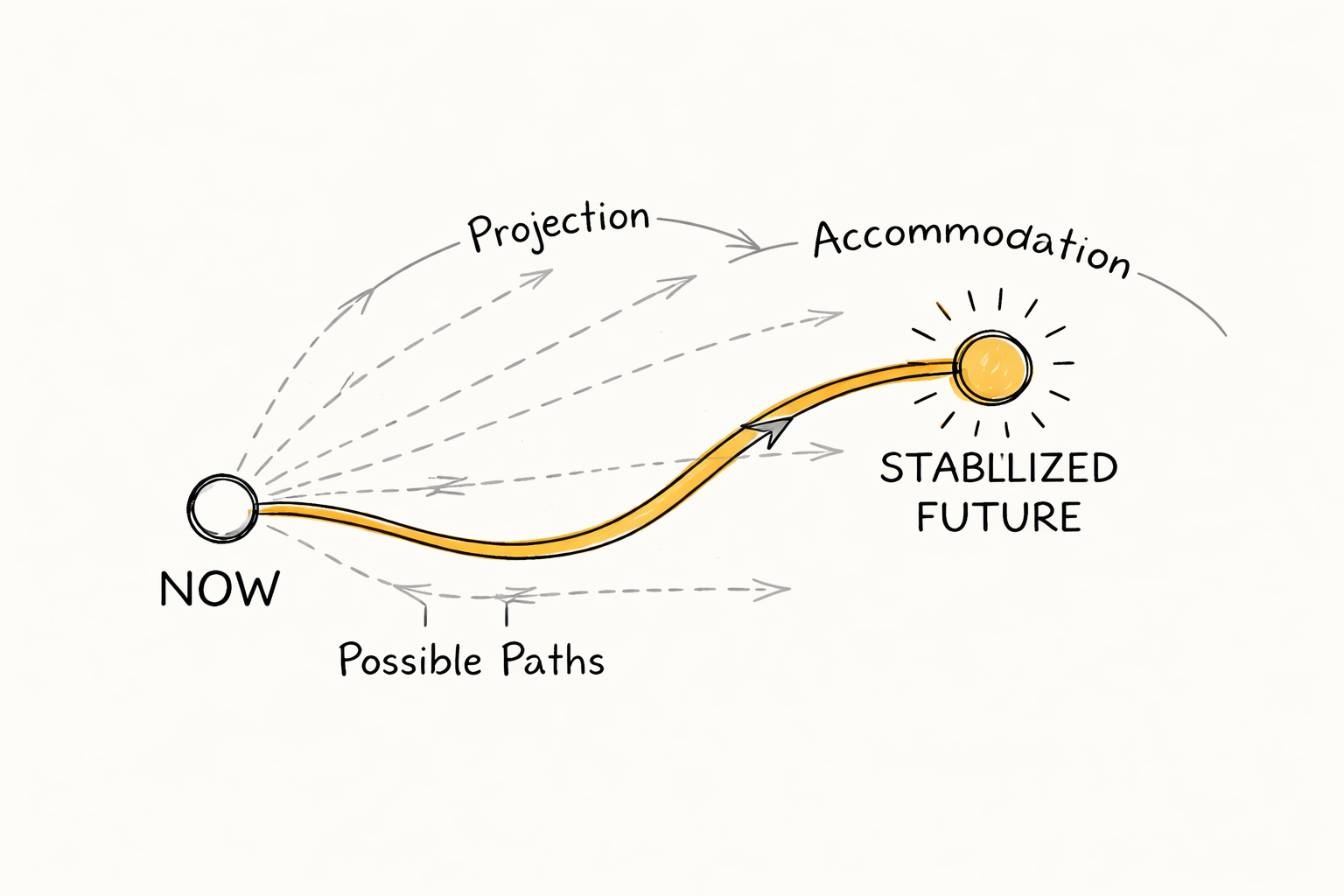
This defines a natural time window τ. Within this window, distributed information can be brought together and treated as one event. Beyond it, the signals no longer cohere, and what was a single event fragments. The present is therefore not a point, but a coherence window determined by the structure and timing of information flow through the system. There are two windows, a process path or decoherence window and an integration, or coherence window. I refer to both as τ, they are non-linear filters, and I do not always separate them, I treat them as the same information process. We take information and reconstruct or deconstruct the spacetime coordinates. One is an observer process the other a spacetime volume process.
I propose that if irreversible change exists inside a specific volume of space-time V, then in the past, within V, the physical state is fixed, while the information required to reconstruct that state has propagated beyond V and is no longer locally accessible. I do not claim that information is fundamentally erased but that it has dispersed into the wider universe. In the future, information has not yet arrived, local microstates are unresolved, and entropy limits reconstruction of physical states that make propositions true.
A critic might say that the Lyapunov time merely marks the limit of our predictive power, and that the future state is fully determined even if we cannot calculate it. In a purely classical system, that objection holds. But in a system governed by general relativity, where the Lyapunov time decoheres the location of events. It is not just a limit on our predictions; it jumbles the path to truth.
This is not a claim that logic itself changes. The logical operators remain classical. The objection that the future is determined but unknown only holds if the physical process is reversible. Irreversible entropy production means that V after the emission is a different from the V before it. The determination of truth is therefore constrained not just by our thermodynamic situation but by the thermodynamic structure of reality itself.
When two spacetime volumes V and V+dV interact, they exchange information through gravitational waves, electromagnetic radiation, and quantum correlations. This exchange updates the information available within each volume, and the determination of truth within each region becomes increasingly aligned as shared information grows. The apparent drive toward consensus is not a logical requirement but a physical result of how information flows, constrained by causality and entropy. This is what produces the observed arrow of time. As general relativity demands, there is not one “now” — every volume V has its own τ(V). As defined earlier, τ(V) is the timescale over which information about V’s microstate becomes irrecoverably dispersed beyond V. This τ(V) is the ‘now’ of that volume.
The Lyapunov time, a change-based duration rather than a coordinate interval, is a suitable finite time-window for τ. It defines a natural coherence or decoherence time over which information about the system can be reliably determined. For a classical system τ is infinite, for a rock almost infinite, for the asteroid race 4 hours, for a mind 3 seconds. It is worth being clear that τ plays three related but distinct roles. The first is τ as a dynamical timescale: the Lyapunov time of a given physical system. The second is τ as an experiential coherence window: the depth of the phenomenological “now” for a cognitive system, constrained by the dynamical timescale of the brain. The third is τ(V) as a local regional now: a decoherence or becoming window associated with a spacetime volume V under general relativity. The experiential τ is bounded by the dynamical τ of the underlying physical system, which is itself a particular instance of the more general τ(V). I have grounded this irreversibility primarily in GR and entropy, I avoid quantum decoherence which offers an independent and, in some respects, stronger basis, but is beyond the scope of this essay.
How does the argument align with my experience
My brain is a complex chaotic system. In such a system the uncertainty grows exponentially from a scale defined by the uncertainty principle to the local area scale on a timescale called the Lyapunov time, which for a human brain is of the order of 100 cycle times. I can hear a 16th of a note at 120 beats per minute and see a stable TV picture at 50Hz, which indicates a cycle time of the order of 30ms, making my Lyapunov time of the order of 3 seconds. This aligns well with my experience of the “now” as a process with depth.
The feeling that there is a “now” and only the “now” really exists, that it is where change happens, is exactly what is proposed here. The width of “now” varies with the complexity of events — as with the tennis player versus the amateur, or an earthquake versus lying in bed. It aligns with the feeling of anticipation and imagination as separate: the first fleeting, the second more stable based on memory. It aligns with surprise when something I thought had happened turns out not to have, as things resolve — a rank outsider won.
My sense of a flowing present moment is a response to my mind gradually resolving the causality and order of events. I am not creating a false belief about the nature of the world. I am recognising that my immediate prediction horizon is limited by chaos. My certainty often collapses at a hard border which is “now”. This is a real “now”, not just a process of my own mind but one of the many processes I sense.
I conclude my essay by stating that the “now” is real and returning to Oliver’s beautiful image, which is not only a decoration in this essay but captures the reality of the falling water, the process, and the always falling and always staying — the argument that a process and an identity are never in conflict.
References
1. Einstein, A. (21 March 1955). Letter to the family of Michele Besso. The original German: “Für uns gläubige Physiker hat die Scheidung zwischen Vergangenheit, Gegenwart und Zukunft nur die Bedeutung einer wenn auch hartnäckigen Illusion.”
2. Valtonen, M. & Karttunen, H. (2006). The Three-body Problem. Cambridge University Press; and Valtonen et al (2016) The Three-body Problem from Pythagoras to Hawking. Springer Cham.
3. J. Ellis McTaggart “The Unreality of Time” (1908) p457-478 the journal Mind (New Series, Vol. 17, No. 68)
4. Broad, C. D. (1923). Scientific Thought. New York: Harcourt, Brace and Co.
5. Oliver, Mary. “The Waterfall.” New and Selected Poems, Beacon Press, 1992.



Leave a Reply