
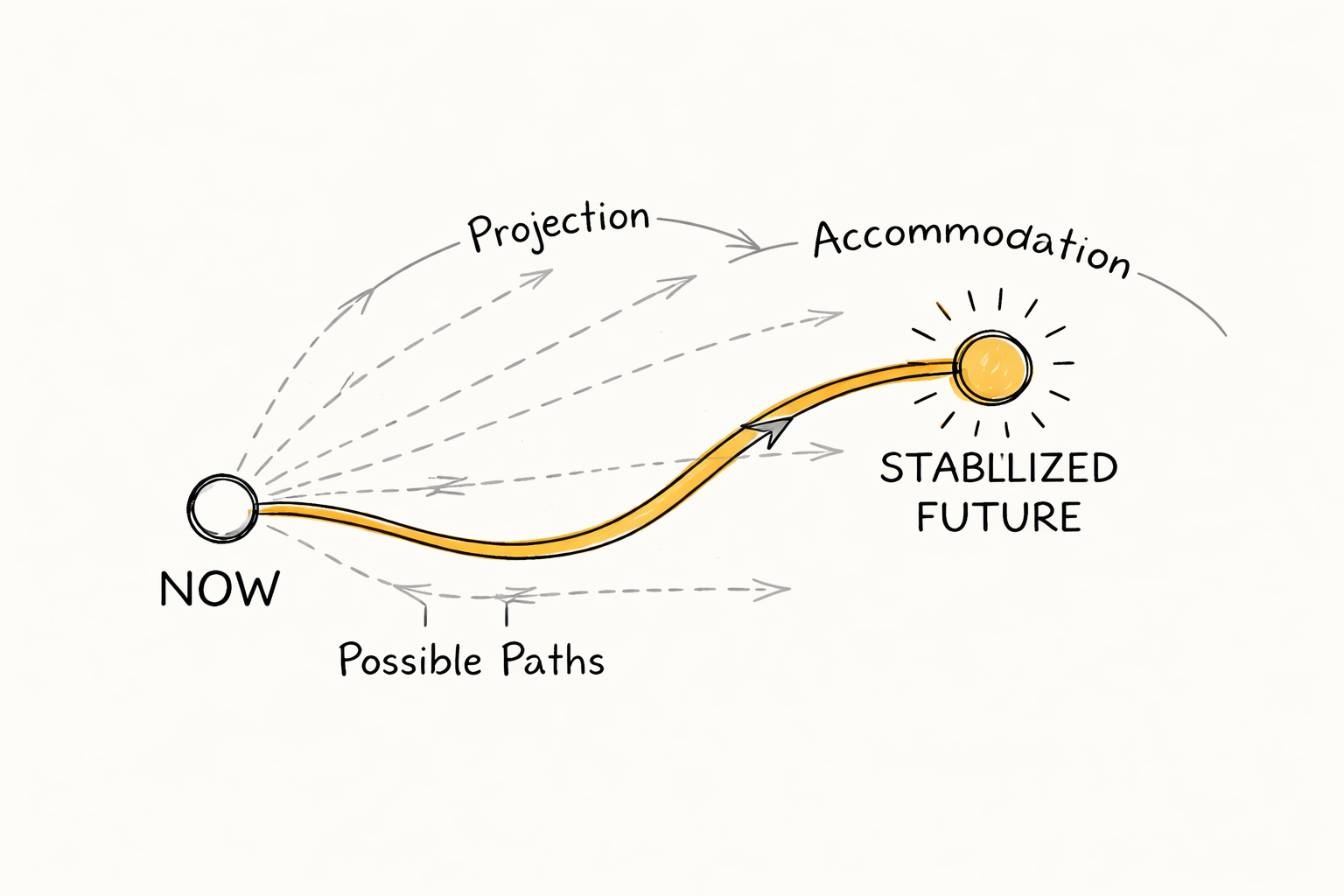
Movement Happens in a two step dance
We are taught to think of motion as simple.
An apple falls because of gravity.
A planet orbits because spacetime is curved.
A particle follows the path that minimises the action.
In each case, the story is the same, it follows the laws of nature.
But there is something quietly missing from that picture.
At any moment, the present state of the world does not know a single future. The future is underdetermined.
So how does motion ever stabilise into a smooth trajectory?
Why doesn’t the apple jitter between multiple admissible futures?
The usual answer is that the actual path is the one that minimises the action. Out of all the possible trajectories, the system follows the best one.
But that assumes something extraordinary: that all possible paths are somehow available for comparison, and that one is selected.
It quietly assumes that the trajectory already exists as a globally evaluable object.
Real physical processes cannot do this. They operate locally, incrementally, with finite information. The universe cannot step outside itself, survey all futures, and choose the optimal one.
So movement must happen differently.
What if motion unfolds in two steps?
- Projection:
The system commits to a locally compatible continuation of its current state. Not the best one — just one that does not immediately violate its relational constraints. - Accommodation:
Future updates must now remain compatible with that prior commitment. They cannot start from scratch. They must grow around what has already happened.
Once the first step is taken, the second step follows automatically: the history of commitments begins to constrain what can come next.
Each new moment must remain compatible with the last.
A trajectory is therefore not selected in advance.
It is stabilised over time.
Smooth motion emerges not because the system has found the optimal path, but because it cannot afford to reconsider all possibilities at every step. The cost of abandoning prior commitments grows as they accumulate.
Inertia, on this view, is not simply resistance to change.
It is the persistence of unfinished consistency.
A moving object continues along its path because each new update must remain compatible with a growing history that cannot be undone.
We often describe motion as the unfolding of a law.
But it may be closer to the progressive stabilisation of a commitment.
The apple falls not because it knows where to go, nor because the best path has been chosen in advance, but because once a locally compatible future is projected, the rest of reality must accommodate it.
Movement may not be a single step from cause to effect.
It may be a two-step negotiation between what is possible now and what must remain compatible later.
Leave a Reply